Tuesday, April 18, 2017

O is for Orkney

O is for Orkney, which is the closest group of islands to the north of Scotland. We visited in May 2016 and fell in love with this very windswept land. There are 70 islands that make up Orkney, but only 20 of these are inhabited.

To get to Orkney from Nairn we drove 125 miles to Scrabster, which is just outside Thurso, and then got the ferry to Stromness, so in total 155 miles. My beloved doesn't do boats so I drugged him up for the journey whilst I went outside and enjoyed the view.


After having a beautiful day for the ferry crossing we woke up the next day to very dreich weather.


Joy, the owner of the Bed and Breakfast we were staying in, suggested some semi indoor activities for us so off we went to visit Maeshowe. This is a chambered cairn that is over 5000 years old - so basically it's the oldest grave site that we've ever visited. You go into the tomb with a guide, ours was Gerry, and they give a really interesting talk about the history of the site. Getting into the tomb was a little bit challenging and Ken wished he had filmed me as we had to bend nearly double to get down the long entrance passageway - I'm the first to admit that I'm not very flexible and a couple of times I nearly got stuck.

Inside there are three chambers where bodies were placed and visited again and again. On the walls there is graffiti that was placed there by Norsemen, descendants of the vikings, in approximately the 12th century. Our favourite of the runic carvings was the one that translates as: "Thofir Koveinsson carved these runes high up", and they were very high up in the chamber - good to see the vikings had a sense of humour.


Our next stop on our neolithic tour of Orkney was Skara Brae. This is a group of 8 homes that have been dated to 3200 BC that had been covered by the sand until a storm uncovered them in the late 1800's. It's a really windswept and exposed spot which explains why the homes are quite low down and the walls are incredibly thick.


When it had finally stopped raining at the end of the day we went to visit the Standing Stones of Stenness which date from before 3000 BC. There is so much ancient history on these small islands, probably as they were one of the first ports of call for anyone coming from the Scandinavian region to invade Britain.


Our second day in Orkney we visited Kirkwall and St Magnus Cathedral which is the UK's most northerly cathedral and it was founded in 1137.


It has a fabulous graveyard (yes I know I'm a bit weird) and inside there are some amazing tombs with great carvings.


Looking down the cathedral - it's a really beautiful space and very peaceful despite lots of tourists coming in and out whilst we were there.


Our next stop was at the Italian Chapel which was made out of two nissen huts by Italian prisoners of war during the second world war. We were really lucky when we first arrived as we had the chapel to ourselves for a short while and it gave a real sense of the peace this building must have given to the Italians that were here. What's most amazing is that all the metal work is made from scrap metal and all the decoration, including the stone work, is painted on.


Here's the two of us showing that despite the blue skies on the second day it was still very, very cold.


The last picture is a very significant picture for me, lovely spring lambs in the fields on Orkney, as this was the moment I decided to give up meat. I'd been debating it for a while, and after a cooked breakfast which was lovely, when I saw these lambs skipping around it just made up my mind. So Orkney is especially dear to my heart.


There you have it, the first of the islands in my A to Z blogging challenge - will there be anymore?? Before you go, why don't you pop over to the main blog and see what other people have come up with for the letter O - click HERE to visit.

Until next time, be good, stay safe, and consider having at least one day a week when you don't eat meat.

Pamela & Ken
xxxxxxxxxxxx


Monday, April 17, 2017

N is for Nairn

Finally in the A to Z blogging challenge we get to N and the town we live in, Nairn. The town was settled by the Norse in 1000 AD, but there is some evidence that there may have been people living in this area as far back as the 4th Century.


It's a lovely little seaside town which is claimed to be the driest and sunniest part of Scotland. There is a small harbour where lots of yachts moor up but in the past it was a herring fishing port.


The harbour was built by Thomas Telford who also featured in my post, D is for Duirinish. It was a thriving herring port until the industry collapsed in the 1930's and it's commemorated by a statue called the Nairn Fishwife. The women, as well as caring for the home and raising the children, collected bait, baited the lines, prepared and smoked the fish, and then sold them through the local area from the basket on her back.


There always seems to be something going on in this little town, and just a week after we'd arrived in the Highlands, 16 months ago, we went down to the beach on new years day to watch crazy people run into the freezing water to raise money for a good cause.


In the 1800's Nairn also became popular due to Dr John Grigor who claimed that bathing in the salt water was good for the health. As a result several grand hotels were built and the Victorians flocked to Nairn to bathe in the waters. Not all the hotels survived but you can still see some of the large victorian homes that were built in west Nairn.

The town is kept looking really pretty by the gardeners and there are lots of beautiful floral displays. This one features dolphins as Nairn sits on the Moray Firth which has the largest school of dolphins in the UK.


There's a bandstand overlooking the green where they play cricket in the summer. There are two golf courses, one each side of the town, and during the year there are organised fun runs.


There's a little theatre which holds all sorts of events, including productions by the local drama club, film nights, and charity events.


One of the biggest attractions in Nairn is the beach which feels like it goes on for miles. In the summer it is very popular with people coming from all over to spend a day on the sand. Even in winter there's usually people dog walking or sitting around a campfire to enjoy the natural beauty.


In July is the Nairn Country Show which is a really fun family day out. It has all the usual things you'd find at a country show including creatures made out of pine cones, farm animals, grand parade of animals, and farm machinery.


In the summer there is a fun fair that sets up home near the bandstand for a couple of weeks - great atmosphere and a chance to be a kid again.


In August is the Nairn Highland Games, a day that really celebrates everything Scottish - massed bands, highland dancing, strong men throwing big things around, and lots of bagpipes playing.


In 2013 the population was just under 13,000 and interestingly there are at least nine churches in the town. It's a really nice place to live and so much quieter than London - we're very glad we made the move.

Here's one of the many lovely sunsets to finish with.


Before you go, why don't you pop over to the A to Z blog and see what my fellow bloggers have come up with for the letter N - click HERE to visit.

Until next time, be good, stay safe, and take a moment to think of the things you like about where you live.

Pamela & Ken
xxxxxxxxxxxx

Saturday, April 15, 2017

M is for Maggieknockater

We've reached the halfway point of the A to Z blogging challenge and I wonder how many of us are needing to seek professional help, or just up the coffee and chocolate intake to get us through the second half.

Todays post is short but sweet. Maggieknockater is a small hamlet which is 40 miles away from us.


There are lots of other M's that I could have done but I just love this place name so much. The mind can conjure up all sorts of reasons for the name, most of them involving a woman called Maggie. Sorry to disappoint, but according to several sources, it's nothing to do with a woman, but derived from a gaelic word that means "plain of the hilly ridge".


There is a traditional Scottish dance called the Bees of Maggieknockater which recalls the fact that there used to be an apiary in the hamlet. Here's a video of the dance:


So, A to M done and dusted. The second half has all sorts of exciting things in store, including an island, alcohol, and the home of Hamish Macbeth. Before you go, why don't you pop over to the A to Z blog to see what my fellow bloggers have come up with - click HERE to visit.

Until next time, be good, stay safe, and do you know the reason for any strange place names near you.

Pamela & Ken
xxxxxxxxxxxx


Friday, April 14, 2017

L is for Loch Ness

We're up to the letter L in the A to Z blogging challenge and living in the highlands of Scotland I had to do Loch Ness. That iconic body of water that people all over the world have heard of, mainly because of the supposed monster living in its depths.


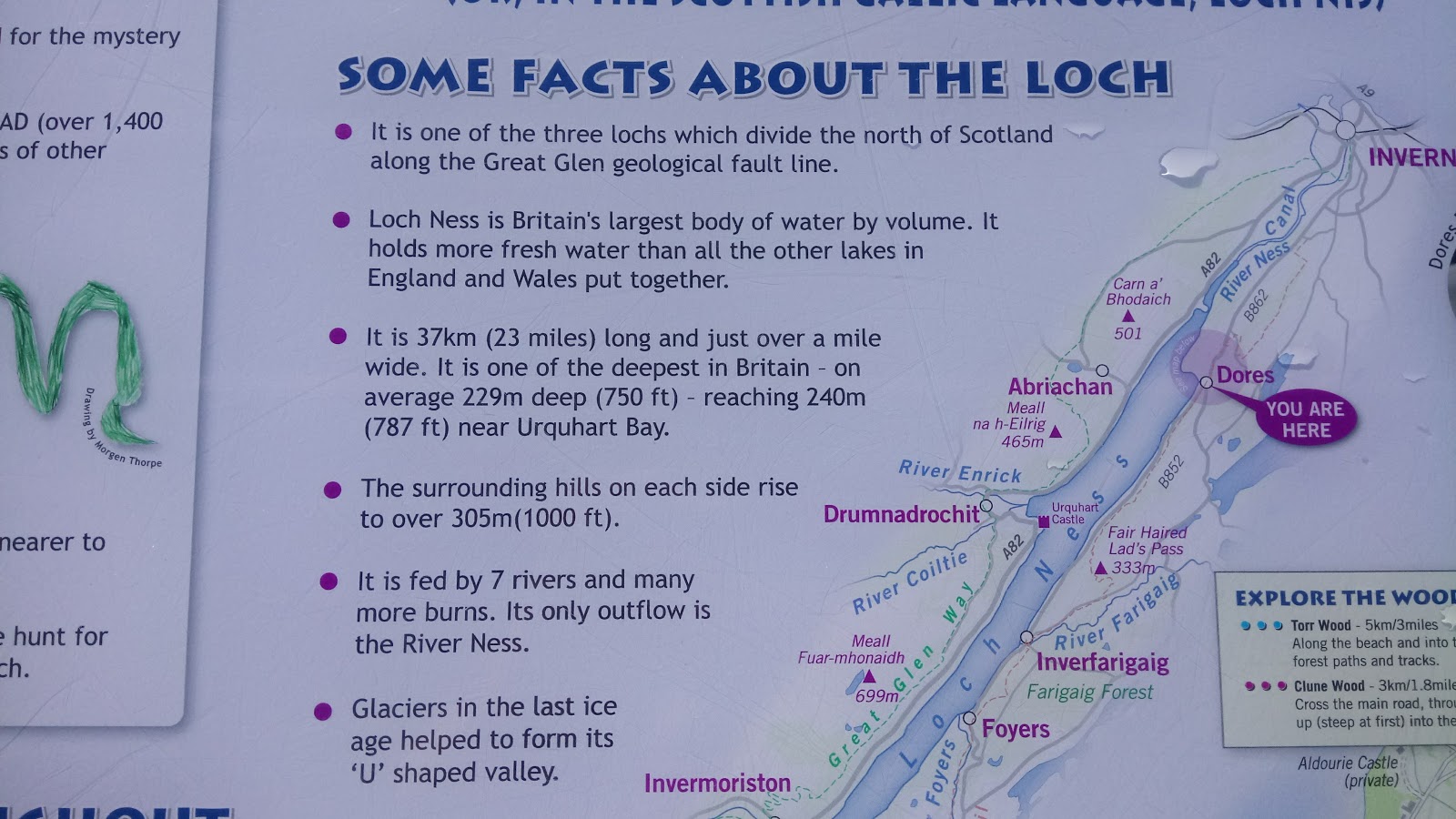
The size of Loch Ness has always amazed me, and especially fact two on the information board below - it holds more water than all the lakes in England and Wales put together!!!


At the north end of the loch is the little village of Dores and a very popular beach that becomes very busy in summer for water sports, but even in winter it's a great place to walk on a crisp cold day as you look down the massive stretch of water.


 The Dores Inn is a great place to eat, and they allow dogs inside, which is always nice to see. I'm sure when she's a little older Bramble may be able to sit still long enough for us to eat a meal with her there.


We both had seared tuna and it was scrumptious.


Now onto the monster that lives in the deep dark waters of Loch Ness, Nessie as she's affectionately nicknamed. According to the information board at Dores, the first recorded sighting of Nessie was in 565 AD and the theories of what Nessie is have ranged from a dinosaur, giant eel, and, my personal favourite, swimming circus elephants.

By the beach in Dores is a camper van with the sign, NessieHunter.com. This is the home of Steve Feltham who moved to Loch Ness in 1991 in order to search for Nessie. This is where he lives full time, even in winter, hoping to catch a glimpse of the monster.


There is a huge tourist industry around the search for Nessie, including cruises on the loch, tour buses that stop at all the strategic points, and lots, and lots of souvenirs to take away a little bit of the magic surrounding the hunt for Nessie the swimming elephant.


There are many cuddly toys.


Oven gloves and biscuit tins.


 Snow globes.


Mugs.


And lots of different items of clothes.


 There were even beers with monster inspired names but that was the point where the shop assistant asked me to not take photos, so you can just imagine what they're like.


Looking across the water you can see clearly why, in the 1950's, John Cobbs decided to use the loch as the place to break the water speed record in his boat Crusader. Unfortunately, after he had broken the record and was slowing down, his boat hit a 'bump' in the water and disintegrated. John, who became the first man to travel at more than 200 mph on water, died shortly afterwards and is commemorated by a cairn that sits beside the A82 overlooking the loch.


At the bottom of Loch Ness is Fort Augustus and it is yet another hot spot for monster searchers. Here's a wire framed Nessie which in the spring/summer is filled with flowers.


We started with a picture taken at the north end of the loch, and here is a picture of the south end of the loch.


So there you have a visit to Loch Ness, a beautiful and huge body of water with lots of history and a giant monster living in the depths. Before you go, why don't you pop over to the A to Z blog to see what my fellow bloggers have come up with - click HERE to visit.

Until next time, be good, stay safe, and I wonder if you have any mythical creatures where you live.

Pamela & Ken
xxxxxxxxxxxx

Thursday, April 13, 2017

K is for Kessock Bridge

We're up to K in the A to Z blogging challenge and as tempting as it was to buy a kilt and get my beloved to model it for you, I've instead chosen the Kessock Bridge.


The Kessock Bridge connects Inverness to the Black Isle, reducing a journey that used to be over 20 miles down to the length of the bridge which is 1056 metres. The bridge opened in 1982 - before that there was also a small ferry, but this went out of operation once the bridge began to be used.


On the drive into work in the morning the bridge dominates my own personal post card image. This was taken before Christmas when there was loads of snow on the mountains.


It's just a quick post today as there's only so much you can say about a bridge. Before you go, why don't you pop over to the A to Z blog to see what my fellow bloggers have come up with - click HERE to visit.

Until next time, be good, stay safe, and treat yourself to something nice today.

Pamela & Ken
xxxxxxxxxxxx